
Flatbed Semi Trailer just saying it conjures a picture of open road, steel and wood, massive loads stretching into the horizon, and expert drivers working with a flatbed delivery truck and transportation dispatch services to make it all happen. But beneath the surface of that simple phrase lies a fascinating world of engineering, logistics, permits, measurements, and history.
Today, we’re going beyond the basics. we’ll explore what a flatbed semi-trailer really is, how it compares to other trailers, what it can carry, and answer the most frequently asked questions that folks in trucking, freight, and even reefer truck dispatch often wonder about.
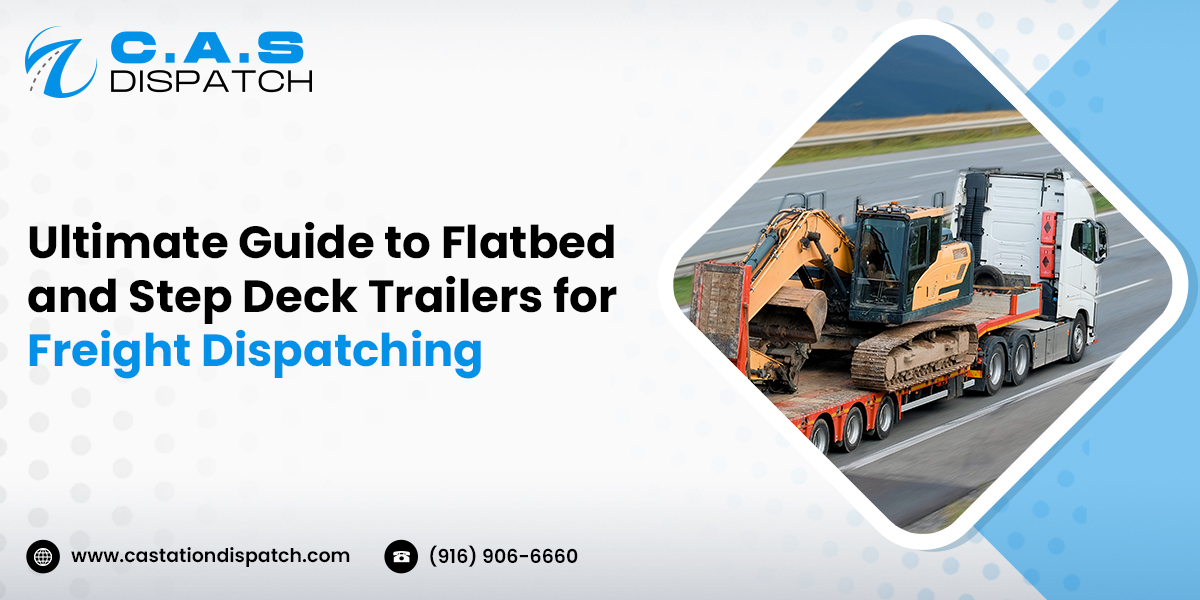
Imagine you’re watching a documentary. A semi‑truck roars out of a yard, but instead of a boxy enclosed trailer, its back is an unadorned, flat platform which seems like almost a giant table on wheels. That’s essentially what a flatbed semi trailer is: a trailer attached to a tractor unit (the “semi”) that offers an open deck with no sides or roof, designed to haul cargo that doesn’t fit neatly inside a box.
Flatbeds are the first choice when cargo is wide, tall, or requires overhead or side loading. And while they are less protected from the elements than a dry van or reefer truck dispatch trailer, their versatility more than makes up for it.
Now comes the part where numbers matter, and trust me, they tell a story all their own.
The two most common flatbed lengths in the U.S. are 48 feet and 53 feet. These sizes evolved over decades based on highway laws, freight needs, and cargo standards. The 48‑footer is the long‑time staple of the industry, but the 53‑footer now accounts for a significant portion of the fleet because it offers roughly an extra 400 cubic feet of cargo space compared to a 48‑footer, a huge deal when you’re charging by volume or pallet spots.
Here’s a snapshot:
|
Trailer Length |
Typical Width |
Notes |
| 48 ft | 8.5 ft | Great for urban and general freight |
| 53 ft | 8.5 ft | Maximum legal length in most states |
| Extendable up to 80 ft+ | 8.5 ft | For extremely long loads |
Legally, most flatbeds are limited to 8 feet 6 inches wide without special permits, a width based on standard highway lane sizes. This footprint also dictates how loads are planned and dispatched by services like transportation dispatch services or reefer truck dispatch when mixed loads are involved.
This is where the rubber meets the road. The question isn’t just “how big is it?” it’s “how heavy can it be?”
For a standard 53‑foot flatbed, most models can haul between 48,000–53,000 pounds of cargo, including the trailer’s own weight. Heavier‑duty or specialized flatbeds with extra axles can push that number even higher for industrial or construction loads.
In practical terms, this means a 53‑footer can carry:
While they’re not as weather‑protected as a reefer, they are often the only practical choice for many types of freight.
People always ask, “Okay, but how much does it cost to rent one of these monsters?”
Rental costs vary based on location, market demand, and duration, but here’s a current snapshot for the U.S.:
| Size | Daily Rate | Weekly Rate | Monthly Rate |
| 48 ft Flatbed | $100 – $150 | $300 – $600 | $1,200 – $1,800 |
| 53 ft Flatbed | $120 – $180 | $350 – $700 | $1,400 – $2,000 |
Those numbers give you a feel for the economics of freight planning and why transportation dispatch services and brokers play such a key role in optimizing routes and loads.
This part is where logistics becomes its own art form.
In the U.S., a vehicle or load that exceeds the standard legal dimensions, wider than 8’6”, taller than 13’6”, or heavier than 80,000 lbs, usually requires special permits known as oversize/overweight load permits. These are typically issued by each state that the truck will pass through.
Permit requirements exist because oversized loads pose safety and infrastructure risks like bridges, overpasses, local roads, and authorities need to make sure a route is safe and appropriate for that size. Without these permits, carriers can face hefty fines, delays, or even have their shipment stopped.
Behind every flatbed rolling down a highway is a dispatch chart, shippers’ needs, loading crews, route apps, and often flatbed delivery truck operators working with transportation dispatch services to get goods delivered on time. Understanding the role of dispatchers and how they manage loads is crucial, for more insights on selecting the right dispatcher for your fleet, see our Guide to Choosing the Best Box Truck Dispatcher.
Trucking dispatchers coordinate loads, drivers, permits, and schedule windows with precision. And fun fact? because flatbeds are so flexible, they often get booked into premium lanes where other trailers can’t go, adding layers of strategy for freight brokers and carriers alike.
If the trucking world had a Swiss Army knife, the flatbed semi trailer would be open, versatile, and capable of hauling shapes and sizes that others simply can’t. From the nitty‑gritty of permitting to the strategic decisions around length, load, and rental costs, understanding flatbeds is a mix of engineering, logistics, law, and road‑tested experience. Whether you’re a carrier, dispatcher, or just freight‑curious, flatbeds offer a fascinating glimpse into the machinery that keeps the world moving.
CA Station Dispatch can connect you with expert transportation dispatch services and help you find the right flatbed solutions for your business. Contact CA Station Dispatch today to explore your options and keep your freight moving safely and on time.
Yes, the “semi” in flatbed semi trailer refers to a trailer that depends on a tractor unit for movement. Without the tractor, it’s just a trailer. In trucking terms, it’s absolutely a semi‑trailer.
If the total load dimensions exceed legal limits (width > 8.5 ft, height > ~13.5 ft, or weight > state/federal limits), oversize load permits are required.
In short:
The 53‑footer’s extra 5 feet makes a big difference when you’re stacking pallets or planning logistics.
Most 53‑foot flatbed trailers have a payload capacity of about 48,000–53,000 pounds depending on axle configuration and build.
Rental rates typically range from $120 to $180 per day, $350 to $700 per week, or $1,400 to $2,000 per month, depending on timing, market, and location.