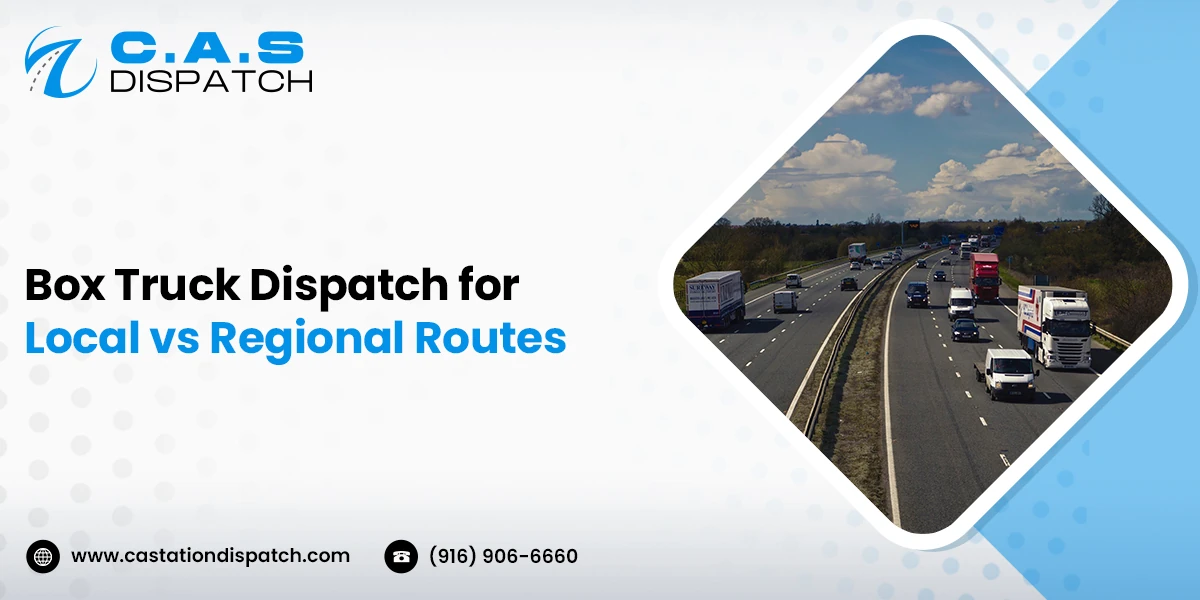
Did you know that nearly 72% of all freight in the United States is moved by trucks? While the massive 18-wheelers often steal the spotlight on the interstate, the “middle-mile” and “last-mile” heroes are the box trucks. Whether it’s a furniture delivery down the street or a medical supply run across state lines, box truck dispatch services are the literal engine of the modern economy.
But for owner-operators and fleet owners, the biggest fork in the road isn’t a GPS direction, it’s the choice between local vs. regional routes. Choosing the right path impacts your fuel costs, your sleep schedule, and most importantly, your bottom line. Let’s break down how box truck dispatch works for both, and how to decide which lane is yours.
Local routes are the heartbeat of urban commerce. In the trucking world, a local route typically keeps a driver within a 150-mile radius of their home base.
However, local driving involves heavy stop-and-go traffic, navigating tight alleys, and dealing with “no parking” zones. This is where carrier dispatch services become vital, as a good dispatcher ensures you aren’t wasting three hours in a congested downtown corridor for a single pallet drop.
Regional routes are the middle ground between staying in town and going full “Over the Road” (OTR). These routes usually span a specific geographic area like the Northeast or the Midwest and typically cover a radius of 250 to 1,000 miles.
Whether you are staying local or going regional, you can’t do it alone, at least not if you want to stay profitable. Box truck dispatch is the art of matching the right load to the right truck at the right price.
A professional carrier dispatch service handles:
| Feature | Local Routes | Regional Routes |
| Average Daily Miles | 50 – 150 miles | 250 – 500+ miles |
| Home Time | Every Night | Every 2–5 days |
| Fuel Efficiency | Lower (Stop-and-go) | Higher (Steady highway speeds) |
| Pay Structure | Often hourly or flat day rate | Usually per mile or per load |
| Vehicle Wear | High (Brakes/Transmission) | Moderate (Tires/Engine hours) |
If you are a solo owner-operator who values routine and wants to be present for family events, local box truck freight services are your best bet. You will develop expertise about your city’s shortcuts while creating ongoing partnerships with local warehouse managers. The strategic way to expand your business beyond city limits is to operate regional routes with your dependable late-model truck. The key is to partner with a dispatch service like CA station dispatch that understands the nuances of regional “clusters” knowing which cities have high outbound volume so you’re never stuck waiting for a load.
The world of box truck dispatch is more about moving life. Whether you choose the familiar streets of your hometown or the open stretch of the regional interstate, success comes down to planning. However, by leveraging professional carrier dispatch services, you can stop worrying about the paperwork and start focusing on the drive.
The primary difference is distance and time. Local trucking keeps you within a small radius (usually 150 miles) and gets you home daily. Regional trucking covers a larger area (several states) and may require spending 1–3 nights on the road per week.
Regional routes are hauls that operate within defined geographic boundaries of a particular country section. A driver might only drive between the Tri-State area and the Pacific Northwest region. The routes serve as connectors between local delivery services and long-distance national freight transportation.
A local route is a delivery path that starts and ends at the same terminal within a single shift. The system delivers packages through short-distance routes which include multiple delivery points scattered throughout a single city or county area.
The industry defines “local” as everything which exists within 150 air-mile distance from the driver’s point of departure. The Department of Transportation (DOT) uses this specific number to establish criteria for logging exemptions.
Highways (interstates and state routes) serve as controlled-access roads that enable drivers to travel at high speeds over extended distances. Local roads function as lower-speed thoroughfares which connect residential areas and commercial spaces through multiple street intersections and traffic control signals.
Yes. Regional operations extend their operational reach to cover more geographic space which includes more distant areas than local operations. The term “big” does not automatically indicate “better” because the definition depends on your particular business objectives.
A direct route is a “point A to point B” haul with no intermediate stops, which shipping companies use for their regional and long-haul freight operations. A local route is defined by its proximity to home and it requires drivers to make several stops because they will collect and deliver smaller freight shipments during their daily work hours.