Did you know that according to the Food and Agriculture Organization (FAO), nearly one-third of all food produced globally is lost or wasted? A massive portion of this tragedy happens simply because the “cold chain” snaps somewhere along the highway. At CA Station Dispatch, we see this as more than just a statistic. Without precise, climate-controlled transport, our global food and medicine systems would effectively collapse within days.
If you have ever enjoyed fresh strawberries in January, you have benefited directly from a high-tech reefer truck. These are not just vehicles but precision-engineered mobile environments that make our modern lifestyle possible.
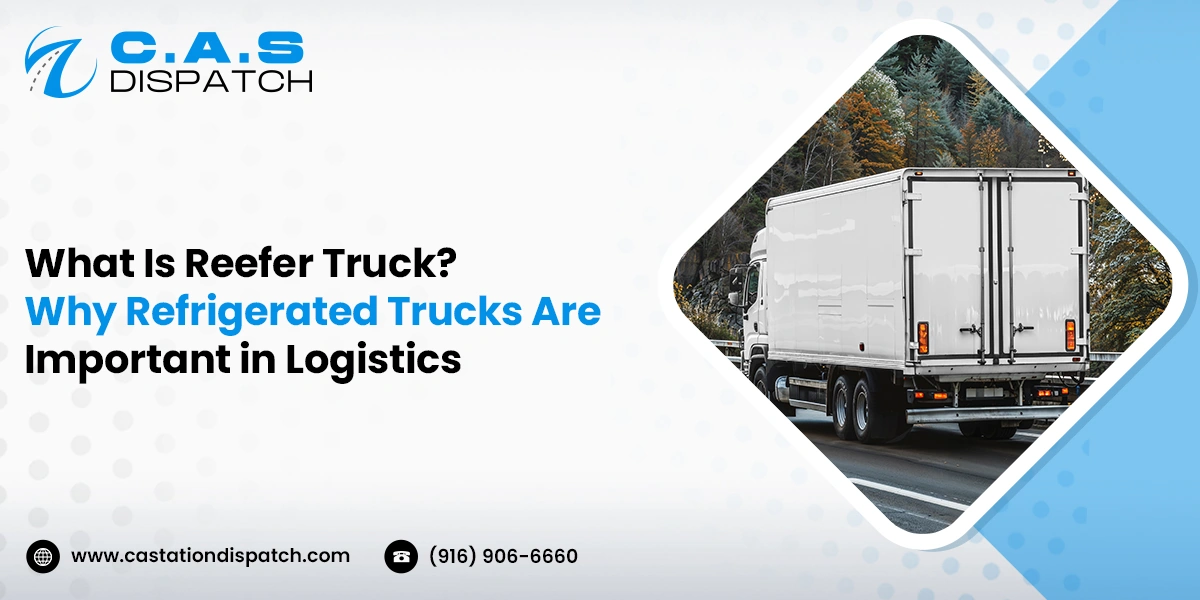
Most people imagine a giant rolling cooler, but the technology behind a reefer truck is much more sophisticated. A reefer truck is a standard semi-truck attached to a trailer that features its own powerful, independent refrigeration system. These advanced systems are the backbone of modern reefer truck services, ensuring temperature-sensitive goods are transported safely and efficiently.
Unlike a simple insulated box that just traps cold air, a reefer actively pulls heat out using a compressor and evaporator. This allows the driver to maintain a steady internal temperature while cruising through a humid swamp or a scorching desert. According to Grand View Research, the global truck refrigeration market is projected to reach $11.26 billion by 2033, reflecting how vital this tech has become.
It is just a shortened, punchy version of the word “refrigerator” used by early truckers. Sailors and drivers trimmed the word down for quicker radio communication, and the name “reefer” has stuck firmly ever since then.
These vehicles carry the most critical, life-saving cargo on the road today, far beyond just milk and eggs.
Operating a reefer is a massive step up from pulling a dry van, requiring extreme attention to detail from carriers.
A veteran driver who insists the real work starts before the trailer doors even close by “pulping” the product. This involves using a probe thermometer to check the internal temperature of the cargo before loading to ensure it is ready. If a load is too warm at pickup, the reefer unit cannot cool it fast enough, leading to a rejected delivery.
Furthermore, cleanliness is mandatory under the FSMA, which indicates that trailers must be sanitized between every single load to prevent cross-contamination. You cannot haul raw poultry one day and fresh fruit the next without a certified “wash-out” to keep the cargo safe.
Operating a reefer is a massive step up from pulling a traditional dry van. While many carriers start with Dry Van Trucking because it’s easier to load and maintain, the reefer side of the house requires a level of attention to detail that only experienced pros can handle.
If you are a carrier considering adding a reefer to your fleet, you are likely looking closely at the bottom line.
The Pros:
The Cons:
Partnering with a dedicated freight dispatcher at CA Station Dispatch makes these challenges easier by ensuring you never sit idle or waste fuel.
Reefer trucks are the quiet heroes of our world, ensuring our medicines work and our food stays safe for our families. While the technical demands are high, the rewards for those who master the cold chain are even higher in 2026.
We specialize in the nuances of refrigerated logistics and understand that a few degrees make a huge difference. Our team is dedicated to ensuring sensitive loads never sit idle so that carriers are always moving profitable, high-quality reefer freight. Ready to keep things moving? Contact CA Station Dispatch today.
A reefer truck is a specialized trailer equipped with an active refrigeration unit designed to transport perishable goods at specific controlled temperature settings.
In logistics a reefer refers to refrigerated shipping container which operates within the cold chain to preserve product quality during extended distance transportation.
The primary purpose is to safely transport temperature-sensitive items like food and medicine which need to remain fresh and effective for the consumer.
The reefer unit functions as a cooling system which creates a controlled climate to protect cargo from external heat and extreme cold and humidity fluctuations that cause spoilage.
The term is industry slang derived from “refrigerator.” It was shortened by truckers for faster communication and is now the standard professional term.
Yes. Most carriers achieve better profitability as their operating costs increase but they often obtain higher freight rates and maintain constant demand throughout the year.